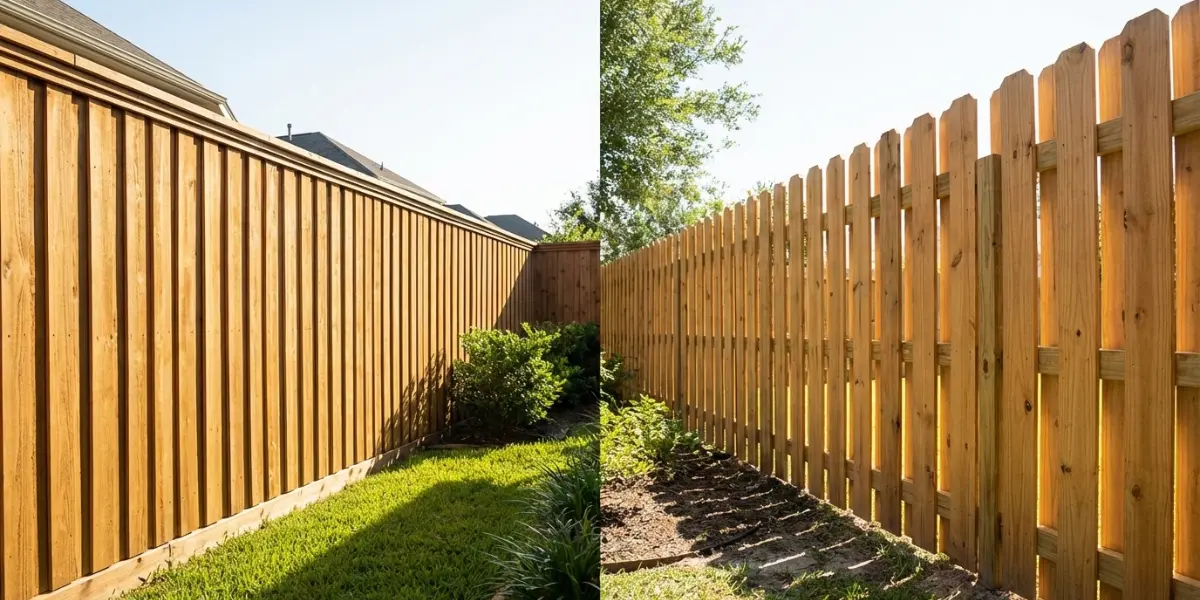
Board-on-board fences provide complete privacy with no gaps. Shadowbox fences have small gaps between pickets that allow some airflow and light through. Both are popular privacy fence styles in the Houston area, and both look better than basic side-by-side fencing — they just solve different problems.
If you’re trying to decide between these two styles, this guide explains how each one works, what they cost, and which situations favor one over the other.
How board-on-board fences work
Board-on-board construction uses overlapping pickets. Each picket overlaps the one next to it by about an inch, eliminating any gaps in the fence. When you look at a board-on-board fence, you see a continuous surface with no visible spaces between boards.
Key characteristics:
- Complete privacy. No one can see through the fence, even at an angle.
- One “finished” side. The overlapping pattern creates a front and back — one side looks better than the other.
- Uses more material. The overlap means 25-30% more pickets compared to side-by-side or shadowbox styles.
- Handles wood movement well. As boards expand and contract with humidity changes, the overlap keeps gaps from appearing.
Board-on-board is the most popular privacy fence style in Houston because it delivers what most people want: a solid visual barrier with no compromises.
How shadowbox fences work
Shadowbox fences (also called “good neighbor” fences) alternate pickets on each side of the rails. One picket attaches to the front, the next to the back, creating a pattern that looks identical from both sides.
Key characteristics:
- Same appearance from both sides. No “ugly” side facing your neighbor — the fence looks finished from every angle.
- Small gaps between pickets. You can see through at certain angles, though the view is partially blocked.
- Better airflow. The gaps allow wind to pass through, reducing stress on the fence during storms.
- Uses similar material to board-on-board. The alternating pattern requires about the same number of pickets as overlapping does.
Shadowbox is sometimes called “good neighbor” style because both you and your neighbor see the same attractive fence. Some HOAs specifically recommend or require this style for that reason.
Side-by-side comparison
| Factor | Board-on-board | Shadowbox |
| Privacy level | Complete — no gaps | High — some visibility at angles |
| Appearance | One finished side, one rail side | Same from both sides |
| Wind resistance | Solid — catches more wind | Better — wind passes through |
| Material cost | Slightly higher (more overlap) | Similar |
| HOA acceptance | Usually approved | Often preferred/required |
| Light through fence | None | Some filtered light |
| Best for | Maximum privacy, pools, hot tubs | Good neighbor relations, HOA areas |
Which style costs more?
The cost difference between board-on-board and shadowbox is minimal — usually less than 5%. Both styles use roughly the same amount of lumber; they just arrange it differently.
In the Houston area, expect to pay:
- Board-on-board (pressure-treated pine): $28-$35 per linear foot
- Shadowbox (pressure-treated pine): $27-$34 per linear foot
- Either style in cedar: Add $8-$12 per linear foot
The bigger cost factors are wood type (cedar vs. pine), height (6 ft vs. 8 ft), and add-ons like cap boards and trim. Style choice is a minor factor compared to these.
See our complete Houston fence pricing guide →
When to choose board-on-board
Board-on-board makes the most sense when:
- Complete privacy is essential. You don’t want anyone seeing into your yard, even at an angle. Pool areas, hot tubs, and outdoor changing areas all benefit from total visual blocking.
- You’re blocking a specific view. Maybe there’s a neighbor’s window, a commercial property, or something else you want completely screened.
- You’re not concerned about the “back” side. The rails face your neighbor’s property, but you’re okay with that (or the fence borders something besides another home).
- Sound reduction matters. A solid fence blocks more noise than one with gaps. If you’re near a busy street, board-on-board provides slightly better sound dampening.
When to choose shadowbox
Shadowbox makes more sense when:
- Your HOA prefers or requires it. Many Houston-area neighborhoods specify shadowbox as the approved style because it’s considerate to neighbors. The Woodlands, in particular, commonly recommends this style.
- Neighbor relations matter to you. Giving your neighbor the “finished” side of the fence is a nice gesture. Shadowbox eliminates this issue entirely.
- You want some airflow. In Houston’s heat, a little breeze through the fence can make a difference in your backyard.
- Wind is a concern. Shadowbox fences handle strong winds better because air passes through. If your property is exposed or you’ve had fence damage from storms, this is worth considering.
- You like the aesthetic. Some people simply prefer the look of alternating boards. It creates a subtle shadow pattern that changes with the light.
Learn about The Woodlands fence requirements →
What about side-by-side fences?
You might also hear about “side-by-side” or “flat top” fences. This is the most basic style — pickets butted directly against each other with no overlap or alternating pattern.
Side-by-side uses less material and costs slightly less, but it has downsides:
- Gaps appear over time as wood shrinks
- Looks more basic/utilitarian
- One side shows rails (same issue as board-on-board)
Most Houston homeowners choose board-on-board or shadowbox over side-by-side because the better appearance and gap prevention are worth the modest extra cost.
Frequently asked questions
Can you see through a shadowbox fence?
Yes, at certain angles. When you look straight at a shadowbox fence, the alternating boards block most of the view. But at an angle, you can see between the gaps. It provides privacy from casual glances but not complete visual blocking.
Which fence style lasts longer?
Both styles last about the same time — 15-20 years with proper installation and maintenance. The wood type and installation quality matter more than the style. Shadowbox may have a slight edge in storm-prone areas because wind stress is reduced.
What does “good neighbor” fence mean?
“Good neighbor” is another name for shadowbox style because the fence looks the same from both sides. Neither you nor your neighbor gets the “ugly” side with exposed rails. Some people also use the term for any fence where the finished side faces out toward the neighbor.
Which style do HOAs prefer?
It varies by neighborhood. Many HOAs accept either style, but some specifically require or recommend shadowbox because it’s considerate to neighbors. Always check your deed restrictions before choosing a style.
Need help choosing?
We build both board-on-board and shadowbox fences throughout the Houston area. We can show you examples of each, explain what makes sense for your specific situation, and help you navigate HOA requirements if needed.
We’ll help you figure out which style works best for your property.