
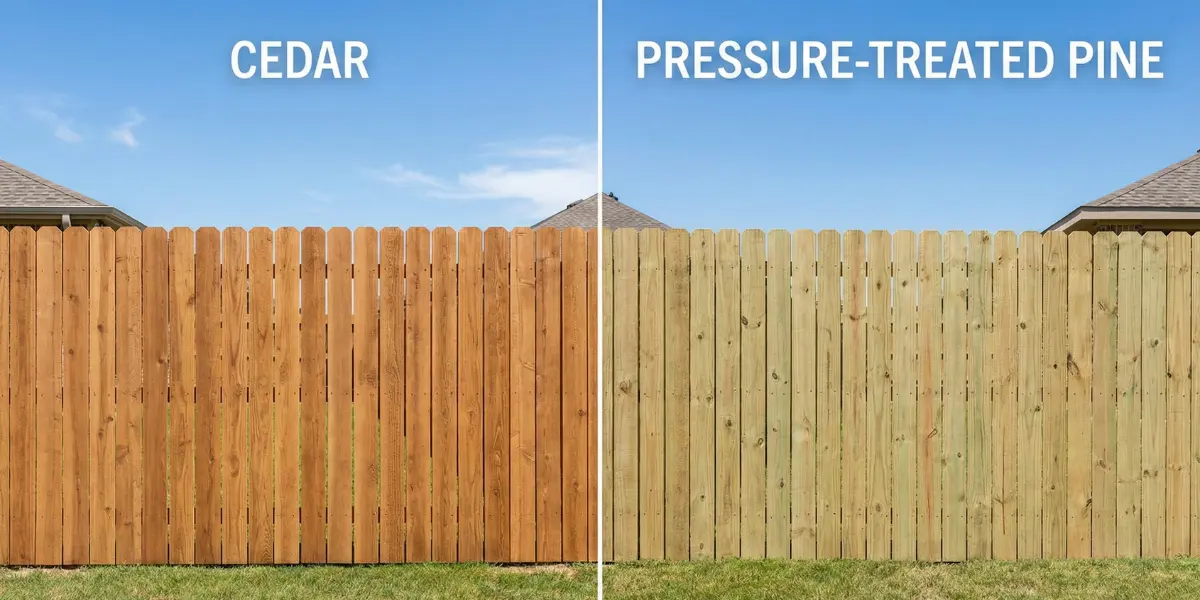
In Texas, a well-built cedar fence typically lasts 15-20 years, while pressure-treated pine lasts 12-18 years with proper maintenance. Both can hold up to Houston’s heat and humidity — they just do it differently, and at different price points.
If you’re trying to decide between cedar and pressure-treated pine for your fence, this guide breaks down the real differences: how long each lasts, what they cost, how they look over time, and which makes more sense for your situation.
The short answer
Here’s what you need to know upfront:
- Cedar costs more (typically 20-30% higher) but requires less maintenance and has natural rot resistance.
- Pressure-treated pine costs less and holds up well in Texas, but the wood is chemically treated rather than naturally resistant.
- Both can last 15+ years in Houston’s climate if installed correctly and maintained. The “best” choice depends on your budget and priorities.
Now let’s get into the details.
Understanding cedar fences
Western red cedar has been used for fencing for generations, and for good reason. The wood contains natural oils — called thujaplicins — that make it resistant to rot, decay, and insects without any chemical treatment.
How cedar holds up in Texas
Cedar handles Houston’s humidity well. Those natural oils don’t wash out in the rain or break down quickly in the heat. The wood also has a tight grain structure that resists warping better than many other species.
That said, cedar isn’t invincible. Prolonged ground contact will eventually cause rot, even in cedar. And without staining or sealing, the wood will weather to a silver-gray color over time. Some people like this look; others don’t.
Cedar lifespan and maintenance
Expected lifespan: 15-20+ years
Cedar requires less maintenance than pressure-treated pine because the wood is naturally protected. However, if you want to maintain the original reddish-brown color, you’ll need to apply a UV-protective stain or sealant every 2-3 years. Without it, the fence will still last — it’ll just turn gray.
What cedar costs
A cedar privacy fence in the Houston area typically runs $35-$45 per linear foot installed. For a standard backyard with 150 linear feet of fencing, that’s roughly $5,250-$6,750.
The price premium over pressure-treated pine is real — usually $1,500-$2,500 more for a typical residential fence. Whether that’s worth it depends on how much you value the appearance and the lower maintenance requirements.
Understanding pressure-treated pine fences
Pressure-treated pine is regular Southern yellow pine that’s been infused with preservatives under pressure. The treatment forces chemicals deep into the wood fibers, protecting against rot, decay, and termite damage.
How treated pine holds up in Texas
Modern pressure-treated lumber (using ACQ or CA-C preservatives) holds up well in Houston’s climate. The treatment protects against the moisture and insects that would quickly destroy untreated pine.
The main vulnerability is UV damage. The sun breaks down wood fibers over time, causing graying, cracking, and surface erosion. This is why staining treated pine every 2-3 years makes a significant difference in how long it lasts.
Treated pine lifespan and maintenance
Expected lifespan: 12-18 years (can reach 20+ with excellent maintenance)
Pressure-treated pine benefits more from regular staining than cedar does. The stain adds a layer of UV and moisture protection that the treatment alone doesn’t fully provide. Plan on staining every 2-3 years if you want to maximize the fence’s lifespan.
Important: New pressure-treated wood needs time to dry before staining — usually 3-6 months after installation. Staining too soon prevents proper penetration and the finish won’t last.
What treated pine costs
A pressure-treated pine privacy fence in the Houston area typically runs $25-$35 per linear foot installed. For a standard 150-linear-foot backyard, that’s roughly $3,750-$5,250. For a full breakdown of wood fence costs by style, material, and neighborhood across the Houston area, see our wood fence cost guide for Houston, TX
This is the most common fencing material in Texas because it offers good durability at a more accessible price point. Most of the fences you see in Houston-area neighborhoods are pressure-treated pine.
Cedar vs pressure treated pine fence comparison
| Factor | Cedar | Pressure-treated pine |
| Lifespan | 15-20+ years | 12-18 years |
| Cost (per linear ft) | $35-$45 | $25-$35 |
| 150 ft fence cost | $5,250-$6,750 | $3,750-$5,250 |
| Rot resistance | Natural (built-in) | Chemical treatment |
| Appearance (new) | Reddish-brown, attractive grain | Greenish tint, less grain |
| Unstained aging | Weathers to silver-gray | Grays, may crack/splinter |
| Staining timeline | Can stain immediately | Wait 3-6 months |
| Maintenance level | Lower | Moderate |
Which should you choose?
There’s no universally “better” option — it depends on what matters most to you.
Choose cedar if:
- Appearance is a priority. Cedar simply looks better, with a richer color and more attractive grain pattern.
- You prefer natural materials. Some homeowners don’t want chemically treated wood in their yard, especially if they have vegetable gardens or pets.
- You want lower long-term maintenance. Cedar is more forgiving if you skip a staining cycle.
- You’re staying in the home long-term. The longer you keep the fence, the more the durability advantage pays off.
Choose pressure-treated pine if:
- Budget is the main concern. Saving $1,500-$2,500 upfront is significant for many homeowners.
- You plan to stain it anyway. Once stained, the appearance difference between cedar and pine is less noticeable.
- You’re selling in 5-10 years. Both woods will still be in good shape within that timeframe, so the extra cost of cedar may not pay off.
- You don’t mind the maintenance schedule. If you’re going to stain every 2-3 years regardless, treated pine performs well.
See our wood fence installation services
A note on quality
Here’s something that matters more than the cedar vs. pine debate: the quality of the installation.
A cheap cedar fence with shallow posts and poor construction will fail before a quality pressure-treated fence with proper footings and solid craftsmanship. The wood matters, but how the fence is built matters more.
Key installation factors that affect longevity:
- Post depth: Posts should be set 24-30 inches deep with proper concrete footings.
- Post-to-ground contact: Good contractors prevent water from pooling at the base of posts.
- Hardware quality: Galvanized or stainless steel fasteners that won’t rust and stain the wood.
- Rail attachment: How rails connect to posts affects the fence’s long-term stability.
When comparing quotes, make sure you’re comparing similar quality, not just price. The cheapest option often cuts corners that will cost you later.
Frequently asked questions
Is cedar worth the extra cost?
It depends on your priorities. If appearance, lower maintenance, and natural materials matter to you, cedar is worth the premium. If you want a durable fence at a lower cost and don’t mind regular staining, pressure-treated pine is a smart choice.
Can you mix cedar and treated pine in the same fence?
Some contractors use pressure-treated posts with cedar pickets. The posts are buried and more vulnerable to moisture, so the treatment helps. The visible pickets get the cedar appearance. This is a reasonable compromise that saves some cost while maintaining the cedar look.
How often should I stain my fence?
Every 2-3 years for best results, regardless of wood type. Pressure-treated pine benefits more from regular staining than cedar, but both will last longer and look better with UV and moisture protection.
Does pressure-treated wood contain harmful chemicals?
Modern pressure-treated lumber uses ACQ (alkaline copper quaternary) or CA-C (copper azole), which replaced the older CCA (chromated copper arsenate) treatment. Current treatments are considered safe for residential use by the EPA. However, you shouldn’t burn treated wood or use it where it will contact food.
Need help choosing?
We install both cedar and pressure-treated pine fences throughout the Houston area — Cypress, Spring, Katy, The Woodlands, and surrounding communities. We can show you samples of both, explain the differences in person, and give you accurate quotes for each option.
We’ll help you figure out which wood makes sense for your situation.