
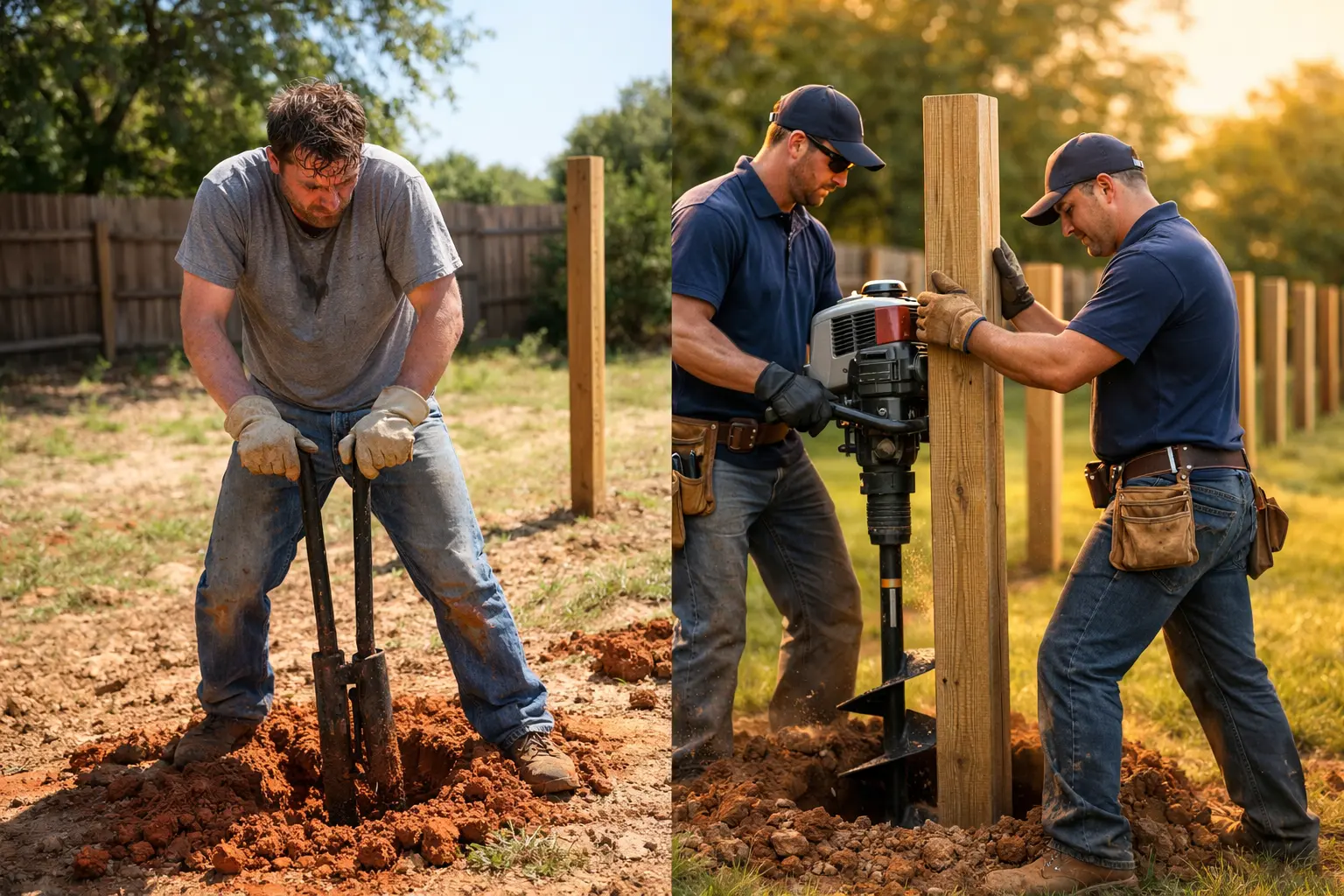
Building your own fence saves roughly 40-50% compared to hiring a contractor — but requires 3-5 full weekends of work, renting or buying tools, and getting the details right. For a typical 150-foot fence, DIY costs around $2,000-$3,500 in materials versus $3,750-$6,750 installed by a pro.
We’re a fence company, so you might expect us to tell you DIY is a bad idea. But the truth is more nuanced. For some people, DIY is a great choice. For others, it’s a frustrating, expensive lesson. Let’s break down the real costs and help you decide.
The real cost comparison
Let’s compare a 150-linear-foot, 6-foot-tall pressure-treated pine privacy fence:
| Cost category | DIY | Professional |
| Materials | $2,000-$3,000 | $2,000-$3,000 |
| Labor | $0 (your time) | $1,750-$3,750 |
| Tool rental/purchase | $200-$500 | $0 |
| 811 locates | Free | Included |
| Mistake materials (~10%) | $200-$300 | $0 |
| TOTAL | $2,400-$3,800 | $3,750-$6,750 |
Savings: $1,350-$2,950 — but you’re trading 30-50 hours of physical labor for those savings. If your hourly rate at work is $50+, the math gets interesting.
Tools you’ll need
Must-have tools:
- Post hole digger or auger: Manual digger ($40) or gas auger rental ($75-$100/day)
- Level (4-foot): Essential for straight posts ($30-$50)
- String line: For layout ($10)
- Drill/impact driver: You probably have this ($100+ if buying)
- Circular saw or miter saw: For cutting rails and pickets ($100-$200)
- Tape measure, pencil, chalk line: Basics ($20)
- Wheelbarrow and mixing hoe: For concrete ($60-$80)
Nice-to-have:
- Laser level for perfect layout
- Reciprocating saw for cutting old posts or roots
- Scaffolding or sturdy ladder for tall fences
The hidden challenges of DIY
Houston’s clay soil
Our clay soil is brutal to dig by hand. When it’s dry, it’s like concrete. When it’s wet, it’s like glue. A manual post hole digger works, but you’ll feel every one of those 20-25 post holes. A gas auger is almost essential unless you have unlimited time and energy.
Underground utilities
You MUST call 811 before digging. It’s free and required by law. But the markings show where utilities are — you still have to hand-dig within 18 inches of them. In older Houston neighborhoods, utilities aren’t always where you expect.
Getting posts straight and level
This is where DIY fences often fail. Posts need to be plumb (vertical), properly spaced, and all at the same height — while also accounting for grade changes. One crooked post affects every panel. Pros have jigs, experience, and tricks that come from doing this daily.
Gate installation
Gates are the trickiest part. They need to be square, properly hung, and have room to swing without dragging. Gate posts need extra depth and size. Many DIY fences look fine except for saggy, sticky gates.
Time commitment
A 150-foot fence typically takes a professional crew 1-2 days. For a DIYer working weekends, expect 3-5 full weekends — assuming no complications. If you hit rock, roots, or utilities, add more time.
When DIY makes sense
- You enjoy physical projects and have the time
- Budget is tight but time is available
- Small project (under 50 linear feet)
- Relatively flat yard with no major obstacles
- You have a helper (this is not a solo project)
- You already own most of the tools
When to hire a pro
- Large project (150+ linear feet)
- Sloped or complicated terrain
- You value your weekends more than the savings
- HOA with strict appearance requirements
- You need it done by a specific date
- Multiple gates or custom features
- You want a warranty on the work
Frequently asked questions
How long does a DIY fence last compared to professional?
If built correctly, the same. The wood and hardware are identical. The difference is in installation quality — posts set deep enough, properly braced, and with enough concrete. A well-built DIY fence lasts 15-20 years like a pro fence.
Can I do part myself and hire help for the hard parts?
Yes. Some homeowners dig holes and set posts themselves, then hire someone to hang rails and pickets. Or vice versa. Just coordinate clearly so there are no surprises about who does what.
What’s the most common DIY mistake?
Posts not set deep enough or without adequate concrete. Houston’s clay soil shifts with moisture. Shallow posts lean within a year or two. Posts should be 24-30 inches deep with solid concrete footings.
Need help deciding?
We’re happy to give you a free quote so you can compare against DIY costs. No pressure — sometimes the answer really is to do it yourself. We’d rather give you honest advice than push you into a project that doesn’t make sense for your situation.
We’ll give you the information you need to decide.